
Grosvenor Gallery and electricity

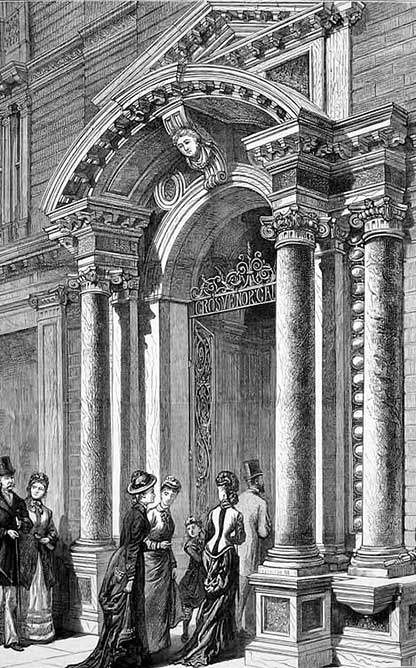
After a brief military career, Sir Coutts Lindsay devoted himself to art and to managing his property. He was a talented artist, whose pictures had regularly been exhibited at the Royal Academy, but he quarrelled with the Academicians over a trivial matter; it led to his work being refused. Many of the younger artists were also unhappy with the very conservative Royal Academy, so Coutts set up a rival, the Grosvenor Gallery, in 1877 for artists whose work was unwelcome at the Royal Academy. The cost was £120,000 and his wife Blanche, granddaughter of Nathan Meyer Rothschild, founder of the British banking dynasty, funded much of the cost. Among the artists who enjoyed his patronage at the gallery were Pre-Raphaelites, such as Edward Burne-Jones and John Everett Millais.
It was at an exhibition at the gallery of James McNeill Whistler’s work that the art critic, John Ruskin, attacked the artist for ‘…charging 200 guineas for flinging a pot of paint in the public’s face’. His remark triggered a celebrated law suit, whose huge costs left Whistler bankrupt, though he won the case, but with tiny compensation.
The gallery was the first to be lit by electricity. Coutts formed a company, with help from other Lindsays, which provided electricity to the neighbours. Its engineer was Sebastian de Ferranti, whose name became renowned in the electrical world. Soon it was selling electricity all over London and built a huge power station at Deptford. After a rocky start, the London Electric Supply Corporation carried on successfully until it was nationalised after the Second World War. Later it was privatized and is absorbed into EDF, a main distributor of electricity in London.